



Glossary of Stitches by Rhiannon E. Scray
To begin embroidering, you will need the following tools: embroidery hoop, embroidery floss, fabric (cotton or linen recommended), scissors, needle, and needle threader (optional). All stitches should begin by tying a secure knot in your thread and pulling it through the underside of the fabric at your desired startpoint. All stitches should end by pulling the thread through the fabric and tying a secure knot underneath.
Traditional Split Stitch:
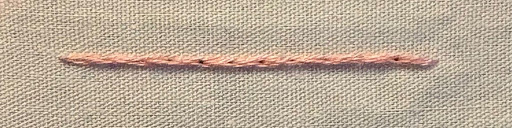
Move one stitch forward and pull through. Underneath, move back half a stitch, and split the previous one in the middle. Pull through and move forward one stitch length. Repeat the process as many times as desired.
The underside will reveal a backstitch.
You might use a traditional stitch when you need to make an outline of an object or figure. When you need to make a simple, straight line. When your family expects that you follow in their footsteps. When your mother expects you to marry someone who can father your children. Split the previous stitch down the middle. Don’t worry, from a distance, it won’t look interrupted or broken.
Back Stitch:

Move one stitch forward and pull through. Underneath, move forward one stitch length, pierce the underside of the fabric, and pull through. Pierce through the end of the previous stitch to complete. Repeat the process as many times as desired.
The underside will reveal a split stitch.
You might choose to use a backstitch when lettering. The precision and cohesion of interlocking stitches allows a seamstress to write in any desired font. To worship the curves of the vowels in her name, to spell it with the softness it demands. You might choose to backstitch when there are no other options. Nowhere to go but the previous stitch, to inch your way forward in baby steps, to test the waters.
Rose Stitch:
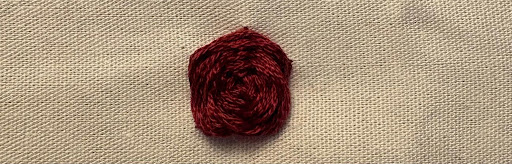
Start by making a pinwheel with five equal length spokes to create a star shape on the topside of your fabric. Once this is complete, on the underside, pull your needle through the fabric near the center and begin weaving your thread through the spokes in an over, under, over, under pattern. Continue the pattern outward until the spokes are no longer visible. Once finished, use the tip of your needle to texturize your rose by lightly dragging it through the petals to separate each individual thread.
The underside will only reveal the pinwheel.
You might use this to create a rose, peony, or otherwise large, blooming flower. You might use this to create more texture or depth. You might use this when you fall in love. A rose will die on her counter, but a rose made of thread will live forever. Use this when you love her and don’t know how to tell her. When you can only show her because you don’t have the language for queer love yet.
Chain Stitch:

Make your first stitch as close to your entrypoint as possible, pulling most of the way through. Leave enough thread to create a loop of your desired size. On the underside, pull your needle through just before the loop on the topside. Make your next stitch as close to the previous entrypoint as possible, on the same side of the loop. Ensure you leave enough thread for your next loop. Repeat this process as many times as desired.
Depending on how close your stitches are, the underside will reveal either a back stitch or a running stitch.
You might choose a chain stitch when you want a consistent interlocking pattern. Perhaps when making a lavender stem or a rain catcher or any other type of chain. You might use this stitch when you fall into an exhausting pattern of your own.
The two of you stay up all hours of the night. She holds your hand and tells you things she won’t share with the other girls and she lets you hear her practice “Blackbird” on her guitar. Her voice will loll you to sleep at night when you hear her through the walls. You sleep just a few layers of plaster apart. From the few times she’s let you in her room, you know you sleep with your beds pressed against the same wall.
The next few nights, she will be too busy for you. Some days she won’t come out of her room at all. Then, she will leave the house for several days and not come back once. She will be radio silent during this time. You will worry about her. Call her. Embroider her something. Ask when she is coming home. Eventually, she will return. You will convince yourself that she is also starting to see you as more than a friend, and that, this time, she won’t leave without telling you.
Running Stitch:
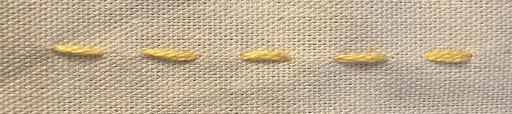
Move one stitch forward. On the underside of the fabric, move one stitch forward and pull through. Repeat this process as many times as desired.
The underside will reveal a running stitch.
You might use this when you don’t need a continuous line. When you feel the floor falling out from underneath you.
She will suddenly, without any warning, find deep fault in you. Despite telling you that she was fine, that she didn’t need you, she will insist that you should have known she was not okay. That the signs were obvious. That you did not care for her at all, in fact.
You will beg her to believe that you really, truly did not know. That next time you will. That you will be better. You will not tell her you love her. You will never find out if she loved you the way you loved her.
French Knot:
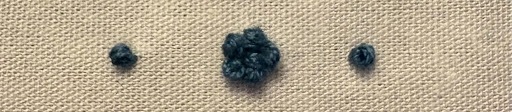
Hold your needle so that the point is parallel to the fabric. Wrap the loose thread around the needle 3 times, or as many as desired, and carefully slide the needle into the fabric, as close as possible to the entrypoint. Pull through.
The underside will reveal a knot.
You might use a french knot when making stars or snow. The inside of a flower. Or a flower itself. Something singular and detached. Perhaps when you get mixed up, when you trip over your own two feet, when you bite your tongue until it bleeds trying to trap the words behind your teeth. You plant yourself in place. You can’t fall if you don’t move. You can’t go wrong if you go nowhere.
Feather Stitch:
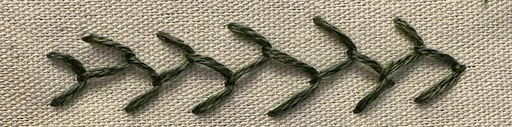
Make your first stitch above your entrypoint and pull most of the way through, leaving enough thread to make a V shape with your next stitch. On the underside of your fabric, pull your needle through one stitch forward, equidistant to the two previous points. Ensure that the thread is looped around your needle as you pull through. Make your next stitch above your last, parallel to the previous point. Pull most of the way through. Again, ensure the thread loops around your needle as you pull your needle through the underside of the fabric, one stitch length forward and equidistant from the previous two points. Repeat this process in an alternating pattern for your desired number of stitches.
The underside will reveal two sets of angled running stitches.
You might use the feather stitch when you are creating branches of a tree or the stems of a flower. When two things come out of one. When you feel yourself being pulled in two different directions, wanting to believe in her, but also yourself.
Daisy Stitch:
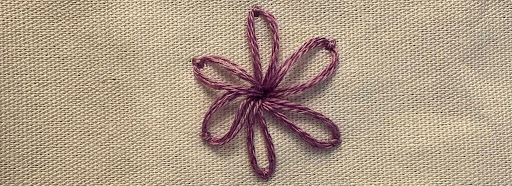
Make your first stitch directly next to where you made your first entrypoint and pull most of the way through, leaving enough thread to create a loop of your desired size. On the underside, pull the needle through one stitch length forward. Before pulling all the way through, hook the thread on the needle. When you pull through, the next stitch should go over the loose thread. Pull taut to firmly hold the loop in place. Repeat with as many petals as desired in your flower.
The underside will reveal a straight line for one petal, or a pinwheel for a full flower.
You might use several daisy stitches to create a more simple flower. To feel at home again. To sit in a room with bubblegum colored walls and daisies on your sheets. To give yourself permission to be innocent once more.
Satin Stitch:
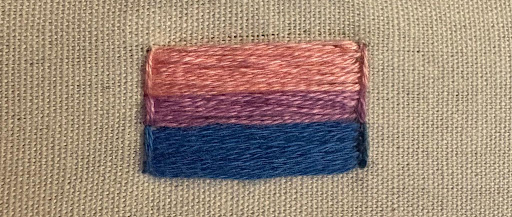
Begin at one edge of the figure you are filling in. Make long, clean stitches running back and forth across the fabric, as close together as possible. The length of your stitch will be determined by the shape of your figure. The number of stitches will depend on how intricate a design you are creating. You can use one or multiple colors. This is the most freeform kind of stitch, but sometimes the most difficult. This stitch requires patience, repetition, attention to detail. The more stitches you use, the more detailed your design.
The underside may result in an outline of the figure or object or it may mirror the topside or it may be a messy collection of random stitches, depending on your method.
You might use this stitch to create very thorough and detailed pictures on your fabric. To create color gradients in the horizon, to show ripples in the water, to capture light resting upon a flower petal. You might use this stitch to demonstrate dedication and effort. To weave a portion of yourself into the fabric. You might use this simply for practice.
Rhiannon E. Scray is an emerging writer from San Bernardino, California. She is a candidate in the MFA program at San Diego State University where she also teaches in the Rhetoric and Writing Studies Department. Her work centers the female body and experience, queerness, memory, language, and coming of age.
12 November 2026
Leave a Reply